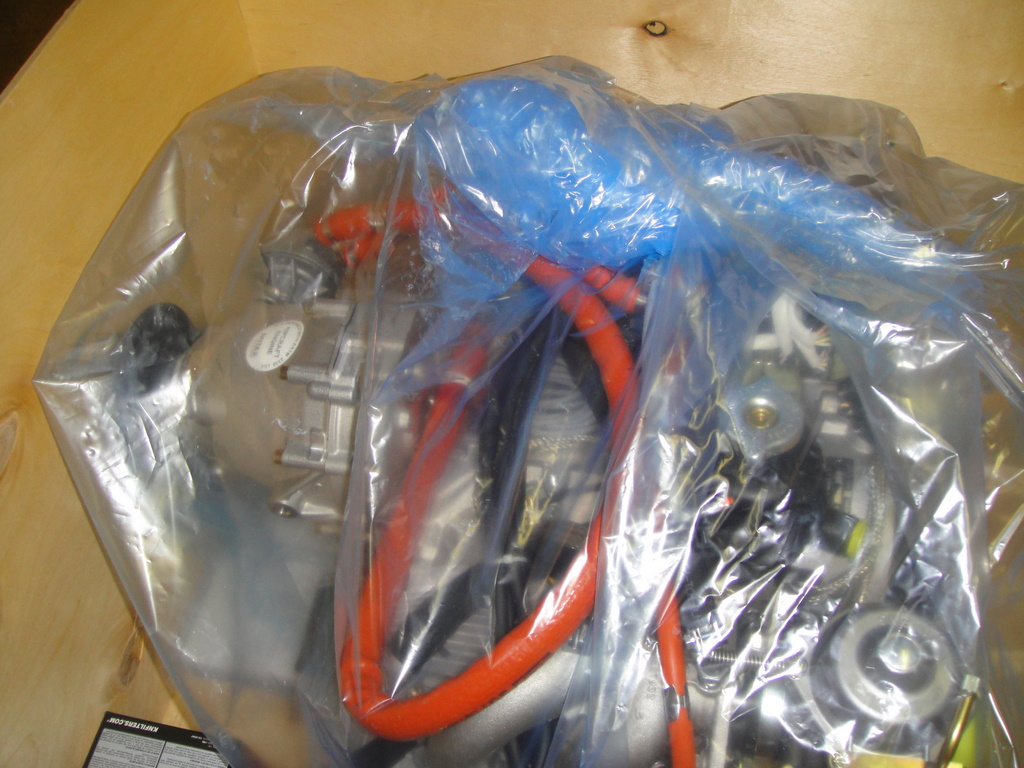
So, what's the first thing that you expect to do when you receive a brand new, $20-some thousand dollar engine? Well, "tear it apart" probably wasn't your first thought.
Mine either.
But when it comes to this, Van's gets to decide 'if', I only have a say on 'when.'
It starts out easily enough: check the 'clocking' on the water inlet fitting at the rear/bottom of the engine and re-position it if needed.
It needed. But it was a piece of cake.
Then a small harness retaining clamp behind a black box called "the ignition module" is removed and the connectors that attach the wire harness to the module are separated.
The first part of this separation involves disjoining the connectors from a metal bracket. It took me awhile to figure out where to apply the blade of the small screwdriver that I was using and in which direction to pry, but once I figured it out the connectors came off easily.
Then the halves of the connectors are separated. Again, once I figured out how to position the blade, it only took a somewhat-more-than-light tug to part them. I wasn't sure if all four of the connectors needed to be parted, so I stopped after the most obvious two. Those are the connectors that Van's had me mark as A1 and B1. So far it seems as if I made the right decision.
The eight spark plug leads are then removed from the spark plugs. They aren't screwed on like they are on a traditional aircraft engine - just tug them off. I was concerned that I wouldn't be able to get them back to their correct spark plugs later, but it turns out that they are plainly marked.
Once they were off, I was instructed to "Pull the lower harness (it should say 'harnesses') as far up between the cylinders as possible." A reason wasn't given, but it becomes apparent later. A combination of pulling on them from above and pushing on them from below got them snugged up into the gap between the cylinders.
Jumping back to the back of the engine, the next step was to remove two cushioned clamps and a spacer, throw away the smaller clamp, the spacer, and the allen screw that was holding them in and replace just the larger clamp using a new spacer and screw. The original lock washer is kept too.
Once that's done, we have to check the gap between "the trigger coil and the trigger cam."
Yeah, I don't know what that means either. For the curious, Van's suggests searching through the Rotax manuals for more info; I decided to just do it. The triggers in question reside behind a plastic cover held in place with three (metric, of course, much to the chagrin of your xenophobic correspondent) bolts.
As luck would have it, the trigger cam was not aligned with the trigger coil.
Putting them in alignment requires turning the crankshaft, and said turning is made easier by removing a spark plug from each cylinder. The fancy looks-like-something-Harbor Freight-wouldn't-even-give-away-free spark plug removal tool provided by Rotax makes this possible, but not easy.
The crankshaft is turned by placing a couple of bolts in the prop hub and using leverage applied via a BFS to turn the crank.
At which point it's easy to ensure the minimum .012" gap (odd that the measurement was provided in inches rather then millimeters - I haven't looked to see if Van's translated for me) and that a .017" feeler won't fit, proving that the gap meets the .012" - .016" tolerance.
I checked the other one too, but I'm not sure that was required. Van's was a little slopped in their pluralities in this instance.
After that brief diversion, it's back to removing the ignition module. This time there are two bolts to be removed. The first is up on top and easy to find/get at. The second is a little trickier - the bolt is impossible to get at, so we remove the retaining nut (only slightly less hard to get at) instead.
Before:
After:
This is when it really started getting scary. The eight screws that attach the intake manifolds had to be removed.
The Harbor Freight allen wrenches came in handy for this. One of the screws was in pretty tight (and there some that weren't tight at all - odd, that) so I used the 'Oomphh' setting on the wrench.
You have to keep a keen eye on these O-rings! One stayed in place, one went with the manifold, and two of them split the difference.
Van's suggests using a cardboard box to support everything as the detached manifold and its pair of carburetors gets lifted forward over the top of the gearbox:
I couldn't get it to even go that far.
The problem was that it was tie-wrapped to the water hoses underneath:
Tie wraps are cheap and easy to replace, so I thought about cutting them, but a glance ahead showed that the problem would soon be mooted by the removal of eight screws, two of which are shown here:
This was made easier by the 'finesse' setting on the allen wrench:
The ball-end lets the wrench work from an angle:
Once the entire top-of-engine assembly was loose, I was able to clear off the top of the engine.
All that was left to do was put a locator mark on this bracket so that it can be returned to the same position:
Use the 'Oomphh' setting to loosen the bolt, then turn the bracket 180 degrees:
Damn! I marked the wrong spot!!
At this point, it seemed that the scary stuff was done.
Ha, not by half!!
The next step was to mark one of the grounding lugs on the starter motor to that it could be cut off!!! I spent a looonnngggg time looking at the drawing:
The superfluous lower mark was just the mark I made to identify the correct appendage for amputation, having not forgotten the incident that resulted in the end of my career in Sports Medicine:
There, now the top of the engine is completely bared:
"Why," you ask? Why does all of that stuff have to be removed?
Well, look back to the title of this post. For our next trick, we're going to fit and attach a cooling shroud!
Well, that's not entirely true; first I need to work up the nerve to cut that grounding lug off of the starter motor.
The furnace is chugging right along and my concerns over another relapse were waning. I'm banking the $300 or so that a professional would have charged. I'm off of the paying job for another fourteen days, and as of yesterday I have an RV-12 powerplant kit in my basement, willing and ready for the lengthy installation process to begin. The timing of the delivery couldn't have been better, and the assistance from Cadillac Pete and his son Warthog made the normally onerous task of breaking down the package and moving all of the pieces/parts to the subterranean assembly shop almost enjoyable. The pizza and beer that followed put the whole thing over the top, well into "truly enjoyable" range.
With things going that well, it came as no surprise when co-pilot Egg came to be with a problem. Her laptop computer, her pride and joy, her non-sentient yet well-loved baby, her very reason to exist (yeah, teenage girl = drama) had rolled over and died. Bought the farm. Met its maker. Gone to its final resting place. Her laptop, sad to say, is now pushing up daisies. And only 366 days into its one year warranty, too. What are the odds??
For some reason, she thought that I could fix it. What an amazing reversal from the girl that was convinced that not only could I not fix the furnace, but was also more than likely going to blow the entire neighborhood to smithereens in the effort.
Still, I am an IT Director, and people may be forgiven for thinking that a lofty title like that makes me all-powerful in the ways of computers. That, and a nerdy demeanor. And there are a few things that can be tried, after all. The most common cause of the type of mid-flight death she had experienced is droppage, but in this case I thought that it was more likely the second most common cause: a dead hard drive.
One of the nice things about laptops is how accessible the parts are, so I went through the normal routine of removing and re-seating the memory cards and hard drive. No luck. I invoked the built-in 'restore' function, which completely lived down to all previous experiences I've had with those, which is to say, it failed.
The next reasonable step is to start replacing parts, but without knowing the exact cause of the premature demise, it quickly can get expensive to troubleshoot via Visa card. Still, BestBuy.com listed a $69 replacement hard drive, and furthermore assured me that the local retail outlet had one in stock if I was willing to brave the just-a-few-days-before-Christmas retail frenzy. It was early in the day, though, so I thought it might be worth a try.
There were none of the $69 drives to be found.
A recent run on them from other people that bought the same laptop 366 days ago, I presume.
They did have a $100 variant that I could try, but to do so would be placing a 25% wager (of the cost of a brand new laptop) that the new drive would actually fix the problem. That's a steep bet. I decided to just bite the bullet and buy a new laptop, albeit one of a different brand.
Ah, just the thing! A nice Samsung, marked down from $579 to $429. Good enough!
I waved down one of the plentiful PFBS (pimple-faced blue shirts) to make the sale. "Nice choice, Sir!" he gushed. And then came the up-sell.
"You know, these manufacturers put all kinds of stuff on there that you don't need and it just slows them down. We'll open it up, test it, and remove all of that stuff for just $159."
Uh, no. Not interested. In my defense, I was still a little testy over the non-existent hard drive and the impending re-balancing of my Karmic (and literal, for that matter) bank account(s), so I wasn't really in the mood for the hard sell.
"Listen, I'm an IT Director. I bought my first computer thirty-five years ago. I know how to remove extraneous crap from computers. No thanks."
I don't often play the IT Director card, and for good reason. No one cares. But in this case, I think it short-circuited what surely would have been five more minutes of trying to sell me on this "valuable service."
The reason for the obdurate failure to take no for an answer soon became apparent.
I grabbed one of the two boxes underneath the display model.
"Oh, those have already had it done," he told me.
"Ah, I see. Well, I'll wait here while you go find an unmolested one for me," I replied.
"Well, there's a problem with that. These are the last two we have."
This is when I put on my best IT Director face and said, "Well, I want this laptop, and I want it at this advertised price. Feel free to put all of the stuff that you removed back on there, if it helps." The finger that thirty years ago would have been poking him in his sternum was instead forcefully poking at the advertised price card on the shelf.
A pause ensued.
"I'll check with my manager, but I think we can give you one of these at that price."
"You damn betcha you can!" I didn't say, but it was a near thing.
So, a holiday disaster averted (poor little Egg would have been devastated at the loss of her trusted Japanese companion - I hope she can accept a Korean replacement) and Karmic balance restored, for whatever that's worth. Now I can (hopefully) shift my attention to the engine waiting patiently in my basement.
Which came in a big box:
Which contained another big box:
And a cardboard box full of all kinds of interesting things:
I let Pete deal with the precision Austrian-engineered box in his inimitably precise manner:
Our first glance at the treasure within:
There she is, proud and tall:
The propeller blades are works of art:
This is the cooling shroud. I've been reading ahead in the plans; the entire top of the engine has to be removed to install it:
Hoses!
Throttle and choke cables:
A ludicrous tool kit:
This is the P36-esque spinner. The hole in the middle is for the pitot tube, not a cannon as it was on the P39:
The muffler:
The mount:
Wiring?? No one said there was going to be more wiring!
The oil tank:
Two radiators - one for water/glycol, the other for oil:
I'm currently sitting warm and snug here in my La-Z-Boy(tm) recliner, basking in the glow emanating from the fireplace at my side. I don't really need the fire, but young Cabot Bennett, himself being a rather thin-haired dog, seems to appreciate it. As he is the only family member willing to get up this early in the morning to provide me with familial companionship, I'm more than happy to provide him with a fire. Really, since it's as simple as pressing a button to light off the propane-fueled fire, why not? If only our other propane-fueled heating device was as easy and reliable....
Yes, I'm still embroiled in a heated (heh!) battle with the furnace, although I think I may finally have won. You may remember that I needed to replace the igniter. Well, that was one of those odd and frustrating situations I seem to get into a lot where more than one thing will break within a brief enough time period to make it look like said breakages are related. The failure of the igniter actually occurred during the time that I was trying to figure out why the furnace was starting only reluctantly. We would hear the flames light off, but the furnace would shut itself down soon thereafter. Then it got to the point where it wouldn't light at all unless I went down to the basement and used a lighter to get it going. That resulted in the aforementioned replacement of the igniter.
While still strutting around like the cock of the roost, all puffed up over having fixed the furnace all by my lonesome, there was a nagging thought at the back of my mind (having been put there by the co-owner, who was not blinded to the possibility that the original problem might still exist in the way I was by virtue of a pocket load of self-satisfaction) that perhaps all was still not well with the heater. Once I got over my inebriating (yet inappropriate as it turns out) buzz of self-congratulation, I was able to see for myself that the job was not quite done.
Fortunately (well, in a way) I have seen a similar problem before. We once paid a repairman to come fix our hot water heater which was exhibiting the same symptoms. When he had made the repair in something like 13 seconds, I was naturally as curious as I was irked, considering that his amortized hourly rate for the repair worked out to the same rate charged by a mediocre neurosurgeon. When queried, we found that all that needed to be done was the cleaning of the thermocouple that tells the computer that the flame is lit. It apparently gets gunked up with some residue from the burning propane. The computer can't tell that the flame is lit, and in an exercise of appropriate caution, it assumes that gas is simply flowing unabated into the room, thereby creating a rather large bomb.
Good thinking, that.
So, all I needed to do was to determine if there is a similar functionality built into the furnace. My steadfast pal Google knew that, and was also immediately forthcoming with an answer as to how to find the probe. "Look to the flame jet furthest away from the igniter," he said, "and there you should see a single electrical wire. Attached to that will be the part you seek.". And true to the word of the Amazing Mr. Google, there it was! It took awhile to figure out how to remove it for cleaning, but as with many magic tricks, it's easy once you figure out how it's done. A quick cleaning with a Scotchbrite pad and voila, the flames remained lit when the furnace was restarted. Self-confidence restored, and another couple of hundred dollars saved!
Except...
It seems that the problem remained. Not as often as before, but it still seemed that there were times when the furnace would not be able to get a good, solid start. "Well," thought I, "clearly I was in the right church but simply occupying the wrong pew. The thermocouple must be worn out. Tired. Over the hill. One foot in the grave, and all that. It should be replaced!"
Well, it's been getting quite chilly in our neck of the continent, so time was again of the essence. I needed to get a new flame sensor installed, post haste. Patience, in this case, would not be scored as a virtue if we all ended up shivering under blankets, huddled around the biggest burner on the cooktop because the furnace was defunct. So, there I was at work, perched painfully upon the sharp horns of a dilemma: how could I order the replacement part without knowing the exact model number of the furnace? Eh, let's be perfectly honest: I didn't know any of the model number. I knew only that the manufacturer was Goodman. The model number, as it turns out, is safely ensconced inside the furnace itself so as to protect it from being seen by mere mortals or DIY furnace repairmen. Or, for that matter, the eyes of the co-owner who, while more than happy to go down and take a look at my request, simply hadn't the time to disassemble the furnace in search of the requisite identifiers. Pressing engagements elsewhere, unfortunately.
Not to worry, for Mr. Google is available to me wherever I may be, thanks be to The Cloud. And how hard could it be to pick the right part from a list, really, what with my having just recently laid hands upon the part in question and theoretically therefore be capable of identifying it on sight?
Google returned the location of an online purveyor who would be thrilled to send me the $15 part overnight for the princely sum of $39.99. And we all know how much I enjoy paying nearly 300% of the cost of a part for shipping. You know, like I have to do now and then when ordering from Van's. Nothing for it, though, so I figured I'd identify the part and get it ordered early enough in the day to meet the overnight-shipping deadline.
It turned out that there were only two choices:
The first choice only listed a handful of matching model numbers, while the second choice had a list a mile long. That was moot, though, since the first choice showed some kind of double-probe configuration, while the second choice showed the single-probe style that I remembered from my few brief moments of cleaning the part. No brainer: it must be the latter part. As painful as it was to spend $51 on a $15 part, I placed the order.
A few hours later, I received a message from the co-owner who, having returned from her errands, had gone down to the basement, removed the front panel of the furnace (no mean feat, that!) and recorded the model number. Figuring that it may be better to be safe than sorry, I returned to the web site only to find the model number listed under the first part, which seemed more than a little unlikely to me given the extra probe included with that particular part. It was then that I decided to look a little more closely and clicked on the image in the time-honored way of making it larger.
Imagine, if you can, my chagrin:
It wasn't a second probe after all!! It was just a dimension line.
Sigh.
I leapt to the phone to call the vendor to see if it was too late to change my order.
"Hi," I started, figuring that such a warm salutation might engender a feeling of helpfulness,
"I have a bit of a problem with a part that I ordered online this morning. I've ordered the wrong part and I'm hoping that I can get it corrected before you ship it out."
I gave the guy the order number, to which he replied, "Ah, it says here that it's been picked and shipped."
"Oh, drat," I replied. "I don't mind so much the cost of the part - it's wasting the shipping cost that bugs me. The wife's going to be irked - this could mean a night on the couch."
I've found that sharing the threat of spousal disapproval often builds a temporary, yet meaningful bond in situations like this.
"Hold on a minute," he said. There ensued a few moments of delay. When he came back on the line, he told me that he "had caught it was it was going out the door." If I was at the computer, he said I could cancel the order and order the correct part and he'd get it out immediately.
I thanked him profusely to which, in the spirit of the healthy badinage that usually accompanies the spousal disapproval gambit, he asked me precisely how much a night not on the couch was worth to me.
"Well," I told him, "not as much as you'd think; the dog cuddles up real nice."
We shared a laugh, and the new flame sensor arrived early the next day. At this point the furnace has been "fixed" more times than a Chicago election, so it only took a few minutes to install the new part and light off the furnace.
Success!!
For a little while, anyway.
Unlike the Chicago Elections Board, we were now as tightly wound as a golf ball when it came to verifying results. Sure enough, it wasn't long before we heard the three failed attempts to ignite that are the hallmark of a flame sensor problem. At a loss, I was, and ready to call in some professional help. For real, this time, not as a back-up to my attempts. But then I got to thinking....
It seems that the reason that the flame sensor is situated in the jet furthest from the igniter is so that the system can be assured that all of the jets are lit. Perhaps only a few of the jets were lighting off and the flame sensor was not getting any flame at all. What could cause that??
I went and looked at the jets. Each is fed by a brass nipple with a small hole drilled in its center. What if......
I found a suitably sized piece of copper wire left over from when I built the stitch & glue kayak. I used the wire to poke thorough each of the holes, thinking that maybe they were grimed up enough to slow down the initial release of gas.
That seems to have helped. We have had a good 24 hours of solid furnace ignition.
Part of me is sure that won't last.
Hopefully it does, though, because the RV-12 engine is to be delivered Monday. I had considered having it delivered to the hangar given how heavy at least one of the parts is, but I couldn't stand the idea of tearing down the engine (as is required for the installation of a cooling shroud and some carburetor drip trays) out there in the cold, dark hangar when I could just as easily do it in my (ostensibly) warm and well-lit basement. Time will tell if I will someday regret that decision, of course, but for now I look forward to a warm and snug work environment.
My discovery of high-end online auto racing came at a very opportune time as I find myself inexorably drifting towards the hostile shores of Boredom Island as I impatiently await the arrival of the RV-12 engine kit. It helps too that I've had some measure of success at it, with the most recent victory surpassing the first in terms of both excitement and satisfaction. The satisfaction comes not only from winning the race but also in no small measure from the fact that this is the first race I've won that didn't require cars in front of me on the track to wreck or spin out. In other words, this was the first race that I won completely on my own merits.
I am the 1%.
The excitement came in the last six laps of the twenty-five lap race. I qualified second, but the pole winner was positioned on the outside of turn one. All I needed was a good enough start to get up next to him and I'd beat him into the first turn and grab the lead. And that is exactly what happened. The next nineteen laps were simply a matter of keeping him a second or so behind me, and as pulse-pounding as those laps were, they were nothing as compared to the finish of the race.
On the nineteenth lap, the guy that had been pushing me from the start must have had a momentary bobble because he was suddenly more than four seconds behind me. Having held him off for more than a dozen laps with him as close as a tenth of a second behind me, I figured it should be a simple matter to cruise through the final six laps to an easy win. I figured that the only things that could derail my victory would be a horrible choke on my part, or an unfortunate encounter with a back marker.
And, as we've all come to expect, merely thinking it was enough to instantiate it. I believe it was only one lap later when a back marker spun right at the apex of a hairpin turn. I can around the turn and plowed right into him. With my nearest competitor only four seconds behind me, there was no time for niceties - I just kept banging on his car until I moved it out of my way. That took just long enough for a car to get caught up with me and pass me as I pushed too hard into the next turn. I resigned myself to a second place finish, but within a lap I had found a weakness in his lap; he was slow into the last turn before the long straight. I leveraged that weakness on the very next lap, but he aggressively moved to block me. Rather than simply fall in line behind him, I braked late and remained on the outside line into the turn at the end of the straight, which allowed me to get up next to him on the inside of the next turn.
All went well for one lap, but on the next lap he got his nose inside of my left rear quarter panel. I couldn't see him there, and by rights he should have dropped back as we entered the turn, but he didn't do so. As I entered the turn, he clipped me and spun me at the apex of the same turn the back marker had balked me in. Luckily, as I spun right in front of him, he tagged me on my left front and turned my car back to the direction I needed to go. Perhaps self-servingly, I took his aggression as a tacit permission to race him a little more roughly than I might normally have done. This amounted to nothing more than a couple bumps against him as I passed him two laps later. After that, it was just a matter of surviving the last two laps.
There. Now that I've provided the narrative, you can see it for yourself in the recording that I made of the race. Note that eighteen of the first nineteen laps have been excised - they'd be pretty boring to watch.
I haven't been completely remiss in my RV-12 work. Here too I concentrated on curves: I sanded down the curved areas on the canopy fairing.
I can't honestly say that I have always known that I have racer's blood in the same way that I can quite forthrightly say that I've always known that I was destined to fly, but the memories of the symptoms are still available as I reflect back on what I can recall of my long ago pre-teen years. In the summer, it was home made carts based on scrap wood and retired roller skates. In the winter is was sleds and anything else that would slide on ice or snow. That was all good, clean fun, but I shudder when I reflect on my first years behind the steering wheel of a real car!
I even went through the karting stage when a track opened in Circleville, just a few miles south of Columbus. I learned a few things about racing over the three year period when I was racing karts:
- I'm a middle-of-the pack guy.
- It's a lot of work and very time consuming.
- It can be very frustrating.
- Money matters, and there is no shortage of people that either have more or are able to apportion a large percentage of their disposable to it. And those are not mutually exclusive, either. There were plenty with both.
- Patience is critical, and I hadn't developed it yet.
- If you don't go home tired and bruised, you aren't doing it right.
What finally got me out of kart racing was fear. There is no roll-over protection in a kart, nor are there any restraints to hold the driver into the seat. Frankly, when speaking of the risk elements, kart racing is closer to motorcycle racing than it is to car racing. Fear made me quit racing, but it didn't cure the itch. Every now and then, I'd go off on one of my research binges where I would dig into a particular marque, thinking that just maybe I could get into racing a real car. There are a number of (what appear to be) relatively low cost options:
Spec Racer Ford is a class of racing car used in Sports Car Club of America (SCCA) and other series road racing events. The Spec Racer Ford, manufactured and marketed by SCCA Enterprises (a subsidiary of SCCA, Inc.), is a high performance, closed wheel, open cockpit, purpose-built race car intended for paved road courses, such as Mazda Raceway Laguna Seca, Buttonwillow Raceway Park, Road America, Watkins Glen, and many other tracks throughout North America. With more than 871 cars manufactured, it is the most successful purpose built road racing car in the United States.
The Spec Racer Ford would be raced at a racetrack like Mid-Ohio, which is only a little more than an hour from home. Cost for a ready-to-race used car would be right around $20,000.
Legends car racing is a style of race car, designed primarily to promote exciting racing and to keep costs down. The bodyshells are 5/8-scale replicas of American automobiles from the 1930s and 1940s, powered by a Yamaha motorcycle engine. The sanctioning body for Legends car racing is called INEX.
Legends Cars are a "spec" series, meaning all cars are mechanically identical, with the exception of 3 styles of car (Standard coupe, 34 Coupe, and Sedan) available with 10 types of body styles. (New cars are currently offered with only 7 body styles, however many used cars exist with the "older" styles)
Legends cars are raced at the Columbus Motor Speedway, right here in town, and at the Kil-Kare track in Xenia (where the Schmetterling Aviation sponsored NASCAR modified driven by my brother races) about 45 minutes away. A brand new Legends car would cost less than $15,000.
Formula Vee is a popular open wheel, single seater junior motor racing formula, with relatively low costs in comparison to Formula Ford or Formula BMW.
On the international stage, Niki Lauda, Emerson Fittipaldi and Keke Rosberg, all Formula 1 champions, raced Formula Vees in Europe or America at the beginning of their careers. In Australia, V8 Supercar drivers Larry Perkins, Colin Bond, John Blanchard, John Bowe, Jason Bargwanna and Paul Stokell were also graduates of Formula Vee.
The class is based on a 1963 Volkswagen Beetle, utilizing a collection of the stock parts to form a competitive race car around a purpose-built tube frame and racing tires. The VW engine, transmission, front suspension, brakes and wheels are stock or modified stock parts. The chassis is a tube frame design and the body is fiberglass or carbon fiber. The intention of this class is for the average person to build and maintain the car.
Primarily a class in the Sports Car Club of America many other organizations have adopted the Formula Vee as a class. Over the years, the rules have evolved to improve performance, lower cost, or to allow replacement of discontinued parts.
The Formula Vee would be raced at the same tracks as the Spec Racer Ford. That would mean either racing exclusively at Mid-Ohio, or travelling hundreds of miles for each race. The cost for a Formula Vee car would depend on the vintage - they've been around for a long, long time. A reasonably competitive car would be between $10,000 - $15,000.
So, what's stopping me? Well, it's fear of injury, but not, as you might think, a fear of injuries resulting from racing accidents. No, it's the fear of what the CFO would do to me if I suggested the adoption of another expensive and time-consuming passion. When you factor in the truck and trailer needed to haul the car, storage for the hauler and race car, tools, maintenance costs, safety equipment, tires, and a nearly endless host of other things, the costs would end up exceeding what it costs for me to fly.
Interestingly, with regards to racing this puts me in the exact same position as the thousands of people that lust for flight but are unable to attain it. It is no secret to software developers such as Microsoft that these people will "settle" for a virtual equivalent in large (and profitable) numbers. With more than 10 million copies of Microsoft Flight Simulator sold, an entire industry has sprung up around what is essentially a computer game, albeit an extremely sophisticated one. There are even groups of hobbyists that act as a global air traffic control system, groups that have organized and manage virtual scheduled airlines, and as many physical accouterments to support the simulator as there are for that most gadget-hungry of breeds, golfers.
The (relatively microscopic) equivalent of the Microsoft flight simulator for the Walter Mitty auto racing crowd is iRacing.
iRacing.com is an online, subscription-based racing simulation service for Microsoft Windows created by iRacing.com Motorsport Simulations. In addition to accurately modeled vehicles and tracks, iRacing provides servers on which to race and practice and a sanctioning body to organize and oversee competition within the service.
From the start, iRacing has been marketed as both an entertainment service and a training tool for real life racers. They have established numerous partnerships with real-world racing organizations and series, including NASCAR, GRAND-AM, IndyCar, V8 supercars, the SCCA, the Skip Barber Racing School, the Volkswagen Jetta TDI Cup, the Star Mazda Championship and Williams F1 among others.
The service was launched to the public on August 26, 2008. As of December 2010, 40,000 individual member accounts had been created.
The iRacing company aims to cater both to real-world racers and racing simulation enthusiasts by offering a realistic simulation of motorsport with accurate track, vehicle and physics modeling, and with all of the cars and tracks officially licensed. iRacing can only be driven online on servers run by iRacing.com, and participation requires a subscription to the service. The subscription package includes a basic set of 10 tracks and six cars with which to practice and race. Additional cars and tracks are subject to additional one-time charges. Vehicles in iRacing are divided into classes which correspond to the identically named driver license classes, except for the two different Rookie car classes which can both be driven with the same Rookie driver license. iRacing creates each track using proprietary Exactrac laser mapping technology to replicate the tracks with millimeter precision.
It is primarily the subscription model that elevates iRacing from 'game' to 'simulation.' There is no shortage of racing games that have an online component that allows for head-to-head racing mano a mano, but the low acquisition cost of those games and the lack of a sanctioning (managerial) body leads to nothing but anarchy on the tracks. Also, games need to sell in large volume to create a return on investment for the developer, and large numbers of people are not going to be attracted to a high-fidelity racing model because the learning curve is far too steep. There are developers that come close, such as Simbin, but none can afford to dedicate the resources to attaining nearly absolute reality in the way that a well-funded subscription-based organization can.
With iRacing, racers have money on the line even to get into a race. That alone tends to influence good behavior on the track, but iRacing goes a few steps further. Because they know who you are (you pay via Visa or other easily identifiable mechanism), they are able to track your behavior by attaching different categories of 'performance points' to your account. These points display to the world whether you are a dangerous jerk or a safety-minded and/or clean racer. A driver's overall safety rating is used as a measure of ability, and this measure determines which of the racing licenses a driver will hold. Everyone starts in the Rookie class, and (hopefully) progresses through the D, C, B licenses on their way to the coveted A license. The license a driver holds determines which racing series he can enter.
Misbehavior in races results in point penalties. Getting too many penalties can cause a driver to lose his license and be returned to the next lower license. It is very, very easy to get negative points, but much more difficult to get positive points. Negative points are assessed for something as simple as getting a couple of tires off track, and progressively more points can be taken for spinning out or having contact with another car. Note that in the latter case, iRacing makes no attempt to determine blame; it doesn't matter if you hit another car or get hit by another car; all cars in any contact incident get penalized equally. The net result of this kind of value rating is similar to the very polite crowd behavior one sees at a gun show: everyone behaves well because the penalties of not doing so are painful.
Positive points are awarded for finishing well in races, and by "well" I mean "better than someone with a lower handicap." Beating higher handicapped racers doesn't do the trick. The license and points held by a racer are often used to ensure that the racer is entered in races against racers with similar rankings. This is smart in a number of ways. First, it encourages newer, less skilled racers to keep racing since they won't be continually demoralized by losing to vastly more experienced drivers. Conversely, it gets the less experienced drivers out of the way of the veterans who would soon become frustrated at tripping over rookies while in a heated race with peers.
Note that I said "often," though. It is not guaranteed. Races are typically started at top of each hour and, despite the international nature of the participants, there can be times when a starting field is too small to allow for a good balancing of participants. For example, consider a race that has only twenty entrants. I don't know the exact algorithm used, but in this hypothetical case, the iRacing system may throw all twenty cars into the same race which could put A license drivers in the same field as rookies, and every skill level in between. Conversely, if there were sixty or so entrants, iRacing could create six 10-driver fields with each group being more closely aligned in skill and ability.
Pricing starts at $12/month, although generous discounts are available for longer subscription terms. No matter the length of the subscription, all services are available. The subscription cost is just the beginning, though. While the entry-level racer has a garage of six cars and nine available tracks to race on, iRacing's financial goal is to sell access to more cars and tracks. This is accomplished by the formation of racing series that use faster, more advanced cars and race on multiple tracks for each scheduled series season.
The six cars included in the base price are:
Note that three of those should look familiar: the Legends car and the Spec Racer Ford (SRF) are in my bullet list of dream cars detailed above. More importantly, note the presence of the Miata. The Miata is a recent entry to the stable and that, combined with this year's Black Friday price reduction of 50% off of a one year subscription, was enough to entice me to sign up for a year. Also, two of the nine included tracks are Lime Rock Park in Connecticut and the world-renowned Laguna Seca track in California. These two tracks are in my list of top five tracks I would love to race at. The remaining three are Mid-Ohio, Watkins Glen, and Elkhart Lake. Those are available for purchase at $14.95 each, and someday I may consider buying them. For now I am still racing with a D license in the rookie series and the tracks required for those series are all included in the base set.
I started with the Spec Racer Ford at Lime Rock Park, partially because that was the car that was scheduled at Lime Rock first. The other reason was because, of the available tracks, Lime Rock is the one I know best, having driven hundreds upon hundreds of laps there in other racing games. The SRF is a purpose-designed race car so it has a multitude of adjustments that can be made to it, but I thought that given my rookie status it would be best to race with the default settings. It's a well-balanced car, which eventually will be a good thing, but it means that it will also be somewhat unforgiving for people used to the forgiving nature of street cars. In other words, it will spin easily.
In the following video, you will be able to see this propensity for rookies to spin the car. You should also note the following:
- Note that I start 4th, make a pass in the first turn to get to 3rd, then relinquish ten positions rather than lose the points that would have been taken for hitting the car that spun in front of me.
- Note that the guy behind my while going into the first turn in lap three was not as careful.
- See how the steering wheel responds to bumps in the track? I have a force feedback steering wheel that uses electric motors to mimic those forces in the physical world. in other words, I can feel every bump and sway in the track.
- Watch how the shadows shift as I go around the track. Also note the reflections in the glass of the tachometer. Cool!!
What the video can't show you is the affect these realistic elements have on me. For the first lap or two, my pulse is well into the hundreds, my hands are sweaty and shaky, and I'm as twitchy as a Chihuahua on an Espresso binge. By the third or fourth lap I start to settle into a slightly more relaxed posture, but that is not to be confused with "calm." The level of concentration required to just keep the car on the rack is intense; get into a bumper-to-bumper race with another car (or group of cars), and the pulse shoots right back up into the triple digits. The races are lengthy, typically running close to thirty minutes.
It feels like five.
Frankly, this online racing, which to the casual observer would look completely sedentary, is the best cardio workout that I get these days.
Perhaps unsurprisingly for my regular readers, having found the SRF to be too stressful I am now almost exclusively racing the Miata. As I was going through various wild scenarios of ways that I could keep my beloved (yet airbag-less) Miata, I briefly considered re-purposing as a race car because the first step in such a conversion is to remove the air bag. That idea didn't even last as long as the discovery of the leaking head gasket but even if it had, the head gasket problem would have spelled doom to that plan. Anyway, the Miata is much more forgiving than the SRF, but it is certainly still possible to spin it. I find it more common now that I've had a few weeks to practice to not spin out of races, but to just lose positions by not hitting the apexes of the turns correctly and thereby losing enough speed to give an advantage to the guy behind me. That, and slowing down to avoid the shenanigans on the rookies that have yet to learn that you need to slow down to go faster.
Another neat thing is that you can customize your paint job.
This scheme has the red of my old Miata and the blue of my soon-to-be new Mustang.
The concept of slowing down to go faster seems odd, doesn't it? It took me awhile to figure it out. I would look at other driver's lap times at Lime Rock and figure that my average 1:02 would leave me distantly behind those guys doing a minute flat. Such has not turned out to be the case. It seems that they are attaining one fast lap for the record books at the cost of dozens of spins and crashes. It's a tortoise versus the hare kind of thing to a respectable degree. In my most recent race, I qualified sixth in a pack of ten. It was a prime time race, so the entry list was long enough to allow me to be paired with nine other drivers in the D and Rookie classes. Those gridded ahead of me had qualifying time in the 1.00.xxx range, while my mid-pack time was something like 1:02.xxx. I figured on starting and finishing mid-pack based on the qualifying times of those in front of me. As can be seen by this results graph, that was not the case.
I got a good start and was able to pass two or three cars going into the first turn as they failed to slow sufficiently to account for cold tires. I worked my way up to the lead, mostly through mistakes made by the impatient cars in front of me. I eventually made a mistake of my own by ignoring one of my personal rules, which is to not try to improve my racing line while in a race - that's what practice is for. I got a couple of tires in the dirt on the outside of turn one and that caused enough loss of traction to get me all the way off the track and into the dirt. While tenderly working my way back to the track (it takes a deft hand to avoid spinning in the grass), I lost four positions, putting me back to 5th. I worked my way back up to 3rd, but couldn't make up the four seconds that separated me from the car in 3rd. Having re-learned the lesson of patience, I was loath to throw away a pretty good finish by trying to drive beyond my normal pace.
I had resigned myself to a respectable third place finish, but as I came around the fastest turn on the track, I saw my opponent sliding through the grass and impacting a wall at a high enough speed to completely flip his car. I never saw what happened to the car that was in the lead, but he must have spun out too; with two laps to go I was back in the lead. This is when the nerves took over again and I had to really work to remain calm. I actually slowed down a little bit, but as the car behind me started getting bigger in my mirrors, I had to step back up to my previous pace. Despite the sweaty hands of a teenager on his first date, I managed to hold on for the win!!
My nerves can only stand one of those a day, so once sufficiently unwound I proceeded on to working on the canopy. Having marked the fiberglass for cutting, I thought it would only be a few minutes work. Unfortunately, I broke the Dremal cutting wheel (again!!) before I was even a tenth of the way done. I decided on a trip to Lowes for new cutting wheels and to see if I could figure out why I keep breaking them. It turns out that I have been using the wrong mandrel. Easily fixed for less than $4.00.
While we were out, Co-pilot Egg had me take her to the thrift store where she hoped to find a suitable garment for "Wear an Ugly Christmas Sweater Day" at school. As I was wandering around the store waiting for her, I came across a beautiful leather jacket in my size for an astoundingly low $30. I snapped that up in a hurry - I've always wanted to have a leather fighter jacket with a cool picture painted on the back, but I never wanted to risk ruining an expensive jacket. For $30, I can roll the dice. Now I just need to come up with a good RV-12 related design, and find someone to paint it for me.
I've done fiber glass work in my basement before, as can be seen by the beautiful kayak that I built as a "Yes I CAN Finish Things" prover project:
This is why I knew that even simple cuts were going to create a lot of dust
See?
Fortunately, I've also learned to never bring that dust upstairs!