Thursday, December 22, 2011

The Shroud of Culin

Or "The Shroud of Cooling," to be precise.

So, what's the first thing that you expect to do when you receive a brand new, $20-some thousand dollar engine? Well, "tear it apart" probably wasn't your first thought.

Mine either.

But when it comes to this, Van's gets to decide 'if', I only have a say on 'when.'

It starts out easily enough: check the 'clocking' on the water inlet fitting at the rear/bottom of the engine and re-position it if needed.

It needed. But it was a piece of cake.


Then a small harness retaining clamp behind a black box called "the ignition module" is removed and the connectors that attach the wire harness to the module are separated.


The first part of this separation involves disjoining the connectors from a metal bracket. It took me awhile to figure out where to apply the blade of the small screwdriver that I was using and in which direction to pry, but once I figured it out the connectors came off easily.


Then the halves of the connectors are separated. Again, once I figured out how to position the blade, it only took a somewhat-more-than-light tug to part them. I wasn't sure if all four of the connectors needed to be parted, so I stopped after the most obvious two. Those are the connectors that Van's had me mark as A1 and B1. So far it seems as if I made the right decision.


The eight spark plug leads are then removed from the spark plugs. They aren't screwed on like they are on a traditional aircraft engine - just tug them off. I was concerned that I wouldn't be able to get them back to their correct spark plugs later, but it turns out that they are plainly marked.


Once they were off, I was instructed to "Pull the lower harness (it should say 'harnesses') as far up between the cylinders as possible." A reason wasn't given, but it becomes apparent later. A combination of pulling on them from above and pushing on them from below got them snugged up into the gap between the cylinders.


Jumping back to the back of the engine, the next step was to remove two cushioned clamps and a spacer, throw away the smaller clamp, the spacer, and the allen screw that was holding them in and replace just the larger clamp using a new spacer and screw. The original lock washer is kept too.


Once that's done, we have to check the gap between "the trigger coil and the trigger cam."

Yeah, I don't know what that means either. For the curious, Van's suggests searching through the Rotax manuals for more info; I decided to just do it. The triggers in question reside behind a plastic cover held in place with three (metric, of course, much to the chagrin of your xenophobic correspondent) bolts.


As luck would have it, the trigger cam was not aligned with the trigger coil.


Putting them in alignment requires turning the crankshaft, and said turning is made easier by removing a spark plug from each cylinder. The fancy looks-like-something-Harbor Freight-wouldn't-even-give-away-free spark plug removal tool provided by Rotax makes this possible, but not easy.


The crankshaft is turned by placing a couple of bolts in the prop hub and using leverage applied via a BFS to turn the crank.


At which point it's easy to ensure the minimum .012" gap (odd that the measurement was provided in inches rather then millimeters - I haven't looked to see if Van's translated for me) and that a .017" feeler won't fit, proving that the gap meets the .012" - .016" tolerance.


I checked the other one too, but I'm not sure that was required. Van's was a little slopped in their pluralities in this instance.


After that brief diversion, it's back to removing the ignition module. This time there are two bolts to be removed. The first is up on top and easy to find/get at. The second is a little trickier - the bolt is impossible to get at, so we remove the retaining nut (only slightly less hard to get at) instead.

Before:

After:

This is when it really started getting scary. The eight screws that attach the intake manifolds had to be removed.


The Harbor Freight allen wrenches came in handy for this. One of the screws was in pretty tight (and there some that weren't tight at all - odd, that) so I used the 'Oomphh' setting on the wrench.


You have to keep a keen eye on these O-rings! One stayed in place, one went with the manifold, and two of them split the difference.


Van's suggests using a cardboard box to support everything as the detached manifold and its pair of carburetors gets lifted forward over the top of the gearbox:


I couldn't get it to even go that far.


The problem was that it was tie-wrapped to the water hoses underneath:


Tie wraps are cheap and easy to replace, so I thought about cutting them, but a glance ahead showed that the problem would soon be mooted by the removal of eight screws, two of which are shown here:


This was made easier by the 'finesse' setting on the allen wrench:


The ball-end lets the wrench work from an angle:


Once the entire top-of-engine assembly was loose, I was able to clear off the top of the engine.


All that was left to do was put a locator mark on this bracket so that it can be returned to the same position:


Use the 'Oomphh' setting to loosen the bolt, then turn the bracket 180 degrees:


Damn! I marked the wrong spot!!


At this point, it seemed that the scary stuff was done.

Ha, not by half!!

The next step was to mark one of the grounding lugs on the starter motor to that it could be cut off!!! I spent a looonnngggg time looking at the drawing:


The superfluous lower mark was just the mark I made to identify the correct appendage for amputation, having not forgotten the incident that resulted in the end of my career in Sports Medicine:


There, now the top of the engine is completely bared:


"Why," you ask? Why does all of that stuff have to be removed?

Well, look back to the title of this post. For our next trick, we're going to fit and attach a cooling shroud!

Well, that's not entirely true; first I need to work up the nerve to cut that grounding lug off of the starter motor.

Tuesday, December 20, 2011

Karmic Malfeasance

Everything was going so well, too.

That's why I was worried.

The furnace is chugging right along and my concerns over another relapse were waning. I'm banking the $300 or so that a professional would have charged. I'm off of the paying job for another fourteen days, and as of yesterday I have an RV-12 powerplant kit in my basement, willing and ready for the lengthy installation process to begin. The timing of the delivery couldn't have been better, and the assistance from Cadillac Pete and his son Warthog made the normally onerous task of breaking down the package and moving all of the pieces/parts to the subterranean assembly shop almost enjoyable. The pizza and beer that followed put the whole thing over the top, well into "truly enjoyable" range.

With things going that well, it came as no surprise when co-pilot Egg came to be with a problem. Her laptop computer, her pride and joy, her non-sentient yet well-loved baby, her very reason to exist (yeah, teenage girl = drama) had rolled over and died. Bought the farm. Met its maker. Gone to its final resting place. Her laptop, sad to say, is now pushing up daisies. And only 366 days into its one year warranty, too. What are the odds??

For some reason, she thought that I could fix it. What an amazing reversal from the girl that was convinced that not only could I not fix the furnace, but was also more than likely going to blow the entire neighborhood to smithereens in the effort.

Still, I am an IT Director, and people may be forgiven for thinking that a lofty title like that makes me all-powerful in the ways of computers. That, and a nerdy demeanor. And there are a few things that can be tried, after all. The most common cause of the type of mid-flight death she had experienced is droppage, but in this case I thought that it was more likely the second most common cause: a dead hard drive.

One of the nice things about laptops is how accessible the parts are, so I went through the normal routine of removing and re-seating the memory cards and hard drive. No luck. I invoked the built-in 'restore' function, which completely lived down to all previous experiences I've had with those, which is to say, it failed.

The next reasonable step is to start replacing parts, but without knowing the exact cause of the premature demise, it quickly can get expensive to troubleshoot via Visa card. Still, BestBuy.com listed a $69 replacement hard drive, and furthermore assured me that the local retail outlet had one in stock if I was willing to brave the just-a-few-days-before-Christmas retail frenzy. It was early in the day, though, so I thought it might be worth a try.

There were none of the $69 drives to be found.

A recent run on them from other people that bought the same laptop 366 days ago, I presume.

They did have a $100 variant that I could try, but to do so would be placing a 25% wager (of the cost of a brand new laptop) that the new drive would actually fix the problem. That's a steep bet. I decided to just bite the bullet and buy a new laptop, albeit one of a different brand.

Ah, just the thing! A nice Samsung, marked down from $579 to $429. Good enough!

I waved down one of the plentiful PFBS (pimple-faced blue shirts) to make the sale. "Nice choice, Sir!" he gushed. And then came the up-sell.

"You know, these manufacturers put all kinds of stuff on there that you don't need and it just slows them down. We'll open it up, test it, and remove all of that stuff for just $159."

Uh, no. Not interested. In my defense, I was still a little testy over the non-existent hard drive and the impending re-balancing of my Karmic (and literal, for that matter) bank account(s), so I wasn't really in the mood for the hard sell.

"Listen, I'm an IT Director. I bought my first computer thirty-five years ago. I know how to remove extraneous crap from computers. No thanks."

I don't often play the IT Director card, and for good reason. No one cares. But in this case, I think it short-circuited what surely would have been five more minutes of trying to sell me on this "valuable service."

The reason for the obdurate failure to take no for an answer soon became apparent.

I grabbed one of the two boxes underneath the display model.

"Oh, those have already had it done," he told me.

"Ah, I see. Well, I'll wait here while you go find an unmolested one for me," I replied.

"Well, there's a problem with that. These are the last two we have."

This is when I put on my best IT Director face and said, "Well, I want this laptop, and I want it at this advertised price. Feel free to put all of the stuff that you removed back on there, if it helps." The finger that thirty years ago would have been poking him in his sternum was instead forcefully poking at the advertised price card on the shelf.

A pause ensued.

"I'll check with my manager, but I think we can give you one of these at that price."

"You damn betcha you can!" I didn't say, but it was a near thing.

So, a holiday disaster averted (poor little Egg would have been devastated at the loss of her trusted Japanese companion - I hope she can accept a Korean replacement) and Karmic balance restored, for whatever that's worth. Now I can (hopefully) shift my attention to the engine waiting patiently in my basement.

Which came in a big box:

Which contained another big box:

And a cardboard box full of all kinds of interesting things:

I let Pete deal with the precision Austrian-engineered box in his inimitably precise manner:

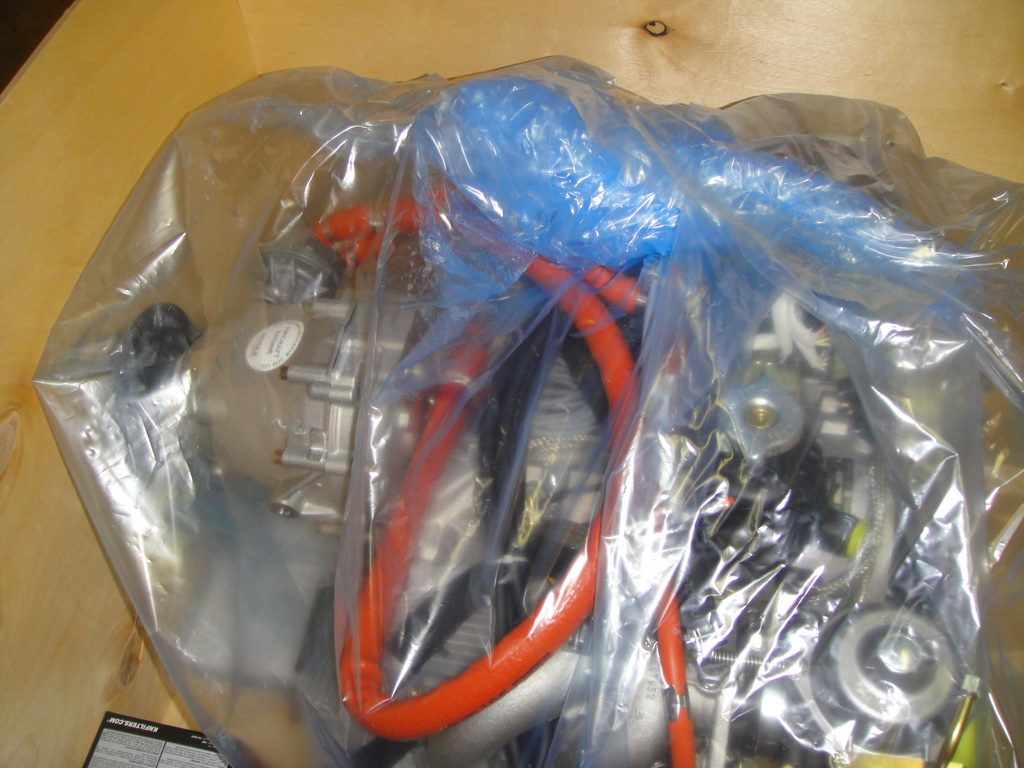
Our first glance at the treasure within:

There she is, proud and tall:

The propeller blades are works of art:


This is the cooling shroud. I've been reading ahead in the plans; the entire top of the engine has to be removed to install it:

Hoses!

Throttle and choke cables:

A ludicrous tool kit:

This is the P36-esque spinner. The hole in the middle is for the pitot tube, not a cannon as it was on the P39:

The muffler:

The mount:

Wiring?? No one said there was going to be more wiring!

The oil tank:

Two radiators - one for water/glycol, the other for oil:

And, as always, plenty of little metal bits.

First step: inventory.